If there is one corporation in the world that has simply been ruling its arena without any real competition, then it has to be the mighty Microsoft. Microsoft Windows is undoubtedly the most easy-to-use operating system and the sales of copies of Windows in the past 18 or so years, is an indication of that. But there is one flaw in Microsoft WIDNOWS that has been there since the first copy of Windows was released. The internal mechanism, by which the kernel of the Windows OS passes control to the individual applications, is susceptible to attacks. Till now, we have seen a host of viruses for Windows systems, but only a few of them exploited this weakness. So, the biggest surprise for Microsoft is yet to come.


Whereas, the number of viruses that have been developed for APPLE Macintosh, is pretty less, the number of viruses, worms and Trojans that have been developed for the Windows, is pretty high. The answer to this question is the same as the answer the question as to why Microsoft Windows has been the most successful operating system till date. The mechanism, with which Windows Kernel makes API calls, is the answer to both questions. It is this very mechanism which makes Windows, both susceptible and at the same time, easy to use and easy to program for. Some Operating System experts trace this anomaly to the fact that Windows was a modified version of the APPLE
Macintosh. Most of us know that Bill Gates from Microsoft had stolen the logic of APPLE Macintosh to build Windows, and since Macintosh was targeted for a specific platform, but Windows wasn’t, such an anomaly had to be there. Whereas the APPLE platform has the Operating System being tied up to the hardware platform, the Windows OS can be used with a variety of platforms.
Actually Windows is based on the Microsoft’s previous OS DOS. DOS was known for being compatible with all the major hardware platforms and was a console based OS. Mr. Gates used the flexibility of DOS and combined it with the Graphical Capabilities that were inherited form APPLE MACINTOSH. Though the tie-up of Hardware and Os in APPLE has lots of advantages like increased processing, lesser vulnerability, better multimedia experience, but the rigidness has always limited the number of users who use APPLE.

But after saying that, even APPLE Macintosh has seen some families of viruses. It’s just that the APPLE family of viruses is targeted towards the firmware whereas the Windows viruses have more to do with files and registries. APPLE Macintosh and Microsoft Windows, both have their own positives and negatives.
On the other hand, the differences between Linux and Microsoft are of a different nature than that between Microsoft Windows and APPLE Macintosh. In simple words, whereas the Windows makes use of the API calling mechanism, the Linux environment uses a Shell. The use of this shell makes you configure your Operating system environment as you like. You can customize the operating system and you can replace the original system codes with your own codes. In short, when you are using the Shell in Linux, you can customize, reconfigure as well as use your operating system at the same time. Moreover, the Linux supports many more file systems than what Windows supports. Linux Os provides much more flexibility and much more security than Windows. The security part comes from Unix- the ancestor of Linux. The way in which file directories are accessed in Unix Kernel, almost nullifies the chance for some virus to cause any trouble. But, there have indeed been viruses targeted for Linux environment as well.


The last two paragraphs tell that there have been viruses for all the three OS, showing that all of them have some weaknesses. Then one could question that why does the number of viruses developed for Windows simply outnumbers the number of viruses developed for the other two. The answer is that the more popular an OS is, the more the number of viruses which are targeted for it. The virus-writers want their viruses to spread as much as they can. This can only happen, if viruses are targeted to infect the most widely used Operating System at that time. Before Windows had come into the scene, most of the viruses were developed for APPLE. And since till date, Windows has seen the largest user base, the largest number of utility applications and the largest number of software suites, it has been the favorite OS of the virus-writers.
Though Windows could have been blown away in its early days, it was saved by its team of security engineers and the upsurge in anti-virus culture. The most fortunate thing for Microsoft was that the anti-virus culture began to pick up just after the release of the Windows. Peter Norton, John McAfee and Eugene Kaspersky came to Microsoft’s rescue. Since Windows was the most popular and most attacked platform at that time, most antivirus corporations decided to provide antivirus solutions for Windows. The Windows users who had already spent so much on getting their copy of Windows, never really bothered about the extra amount that they had to pay for purchasing an antivirus solution. The team at Microsoft also played intelligently, by providing free security patches to the Windows users, over the Internet. Though, the idea of leaving permanent vulnerabilities in the actual code, and patching code for dealing with threats as they arrive, is not good, but why would the user bother about this. The antivirus solution and the security patches made the user feel good while using Windows.


The other thing which went in favor of Windows was that it was ready to use. All the codecs were there since you had installed your copy. These codecs are not available in Linux and you have to add them by yourself. The normal user hence always preferred Windows over Linux, so what if Windows charges you so much and Linux would have cost you nothing. As the base of Windows users grew up, all the major Generic software developing corporations chose Windows as the target platform. The .EXE of Windows became the most popular file format, off late. Hence, with time, Windows became the favorite Operating System of the masses. With time, its dominance increased only.


But then, what about the problems in Windows? Careless coding which was done initially had to manifest, in the end. For a user who used his Windows as badly as he could, had to format his computer every six months. With time, registry problems, invalid file associations and viruses would slow down your processing to such an extent, that you will have no option but to reinstall Windows. This has always been provoking frustrated Windows users to switch to some other Operating System. In fact, in the USA
The problems with Microsoft Windows, they decided to switch back to APPLE, even though an APPLE PC would cost twice as much as one that runs Windows. Since most of the popular applications had their APPLE Mac versions, the users had no problems in switching to APPLE and they did. But the corporations who needed more flexibility than what APPLE would have provided them, stuck to Microsoft.

So what is it that made Microsoft Windows survive, even after having so many problems? It survived partly because of its luck, partly because of the corporations that depended heavily on it, and partly because of the users who got satisfied with what they had. The antivirus companies, in fact, had the biggest role to play, in saving Microsoft’s skins. But they had to do what they did. If they did not work to save Windows, they wouldn’t have got anything to offer to the customers. Hence, on one hand Windows depended on the antivirus companies for its survival, and on the other hand, the antivirus companies had to depend on the weaknesses of Windows for their survival. The patching up of security updates, over the Internet also saved Windows. But the biggest thing that came to Microsoft’s rescue was the lack of options that users had. The users were willing to spend any money on their OS, but they were not willing to spend a lot of time in setting it up. Though Linux provided them with all that Microsoft did, and that too at a lesser cost, the fear of spending time in setting it up, made them stick to Microsoft. Moreover, all the major utility software was available for either windows or Mac, and not Linux. This is how Windows survived the test of time.

Over time, users from the developed countries, where piracy is minimum and you have to spend a handsome amount to get your copy of Windows, users began to feel that if they can spend some time in learning Linux and setting it up, then not only they can save their skins by the weaknesses of Windows, but they can also save their money. Hence, the Open Source culture became much stronger than what it was at its very inception. More and more users began to use Linux and those who did so, never even looked back at Microsoft. For those applications, where only a Windows executable was available, WINE came to their rescue. Slowly and slowly, the distribution channels of Open source software widened up and more and more users started to show interest in using such software. The open source community also began to build utility software which would work on both Linux as well as the commercial operating systems. The Mozilla firefox web browser project and open source suites like OpenOffice.Org are some early examples of this. With time, the open source community got heavily into developing applications specifically for Linux and as a result, a lot of utility software became available to the Linux users. At present, Linux distributions as large as 5 GB, are available. Such distributions have almost all the utilities which one could expect a normal user to use.
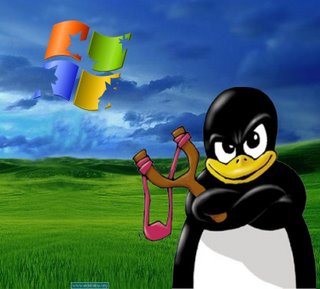
Companies, who have seen Microsoft as their biggest rival, began to fund GNU and assist it in acquiring codecs and the free CD program. The number of Linux users increased considerably in the last 10 years or so and is increasing at a very high pace. PCs that had one or two Windows versions, now had Windows + Linux in dual-boot or only Linux. With this surge in Open Source culture, players like Google and Oracle joined in. Lots of Open source applications began to develop and lots of users started contributing to the Open source community. As it stands now, the Open source culture is at its peak as far as developed nations are concerned. But as far as the developing countries like India
So what threat does the Open source culture pose to Windows? Well, if the GNU is able to acquire most of the paid codecs, then the Open Source OS will provide functionality equivalent to Windows Os, for free. Plus, the most popular Open Source OS Linux, is known to be much more secure, fast and flexible than Windows. Hence, once the users feel like switching to Linux, they might never look back at Windows. Of course, it’s a long time for all the codecs to get acquired by the GNU, but once this gets done, the road will get very difficult for windows. Google is about to release its new Operating System called Chrome.

The company has spent lots of bucks and claims it to be a revolutionary type of OS. Experts believe that Chrome might be having inbuilt support for many codecs and may also have an inbuilt functionality for supporting Windows API calling mechanism(Unlike in Linux, where WINE is separately available and not a part of the OS itself.) Hence, Google Chrome OS may just do what Linux couldn’t do in the past so many years.

The company has spent lots of bucks and claims it to be a revolutionary type of OS. Experts believe that Chrome might be having inbuilt support for many codecs and may also have an inbuilt functionality for supporting Windows API calling mechanism(Unlike in Linux, where WINE is separately available and not a part of the OS itself.) Hence, Google Chrome OS may just do what Linux couldn’t do in the past so many years.
What all can save Windows? Its quite obvious that Windows will stay in the arena for at least the next decade, but its existing-base has already begun to shrink. One thing that can save Windows, is obviously by removing the flaws by building next Windows from scratch, But this does not seem to be a viable solution. Building the next version from the scratch will make it pretty different from the ones that we have already seen. This may render the new versions incompatible with the older ones. Hence this solution will need a lot of insight and investment, and Microsoft as we know it, would prefer continuing on the Automatic update philosophy to this. So what else can save Microsoft’s skin? The answer follows.


If there is one thing that can come to Window’s rescue, then it is the DOTNET platform. Microsoft has spent millions of dollars in developing it and is keen to spend millions more in making further improvements in it. The framework is a conglomerate of multiple programming environments such that the programmer is allowed to code in his favorite language but the overall system would generate a .EXE and a set of DLLs, so that the application, no matter what language it was built in, can be executed on Windows. The Framework realizes this by making use of transforming code from native compiler to an intermediate Language called MSIL (Microsoft Intermediate Language). Then the final compilation would include compiling MSIL code and producing .EXE and the DLLs. If your target environment is Windows, then it is much easier to code in .NET than to code in Java and other development frameworks. The platform provides much more flexibility than any other platform, just because it has been optimized for a target system, rather than being platform independent in order to be deployable on various environments. Moreover, integrating with Ms Office and SQL Server as well as the other Microsoft services, goes seamless with .NET. The company has already invested a lot in maintaining and extending the framework and the dividends have been evident. The platform gives tough competition to Java. The timing of introducing the platform was pretty tactical. Just when Java programming was at surge, Microsoft chose to tempt the Windows developers by introducing DOTNET. And with time, Microsoft has been attempting to show that it’s the best programming platform, if you are a Windows developer. All the latest technologies from Microsoft have been integrated into .NET and hence the .NET programmer has much more flexibility than a Java programmer, when writing code for Windows. As a result, Windows, which was already popular, may become more popular because of the quality of applications that you can produce for it. Currently, .NET and Java are the most widely used development platforms and as long as this stays, Windows will remain in the race.


Having said about the competition which Windows is bound to get from the Open source community, Microsoft will always have the option of doing something to delay the inevitable. The company has a great marketing wing, and the strategies which it uses can make its user base grow instead of shrinking. The company is always known to tempt the customers with great tie ups. At times, it tied up with Japanese computer Manufacturers and Intel to provide a PC that would cost half as much as APPLE PC., and at times it has tied up with Server Manufacturers to provide corporations with irresistible packages. Microsoft’s support is also something which makes users feel as if Microsoft can serve them better than anything. Though the computer companies will not be affected pretty much even if Windows gets phased out, but almost all the computer companies have reaped in heavy profits by providing a combination of Hardware that was specifically designed for Windows. The companies may also worry that what would happen if APPLE begins to reclaim the share once Windows gets phased out. If users turn to APPLE, then no one would buy those simple computers. Hence, Microsoft is due to get full support from computer manufacturers so that Windows stays alive.


In the world of computers, nothing can be predicted with cent percent surety. In 1970’s, the CEO of DEC(which was the leading computer manufacturer at that time, courtesy of its VAX computers) was asked that why isn’t the company entering mainstream PC manufacturing. He replied that “what would a normal user do with a computer?”. He said that 10000-20000 powerful computers are sufficient for the entire world. The company was blown away in the PC revolution of the 1980’s, showing that in the world of computers, lack of insight can be fatal. Windows is the heartbeat of Microsoft. If Windows gets phased out, the company will be virtually nothing in comparison to what it is today. So, at the end of it, if Microsoft shows enough insight and acts accordingly, it can make Windows remain what it is today – the most used OS. Otherwise, the company may become history, like DEC. The choice is theirs and the ball as of now, is in their court.


